 RoutrGet Routr
Make the defender follow your receiver
Against man coverage, a defender follows a receiver instead of waiting in a fixed area. Give that defender a path to chase, then look for the moment your receiver separates. Crosses, pivots and switch releases create different kinds of movement for the same quarterback decision: find the open receiver.
Teach the first move and finishing direction together. A receiver who rounds a pivot gives the defender time to follow. A crosser who slows in the middle loses the separation created by running across the field. Work on those route details before asking for a more complicated call.
Keep your quarterback’s eyes on the relationship between receiver and defender. A receiver running alone on a diagram may have a defender waiting in the throwing lane during a game. Lead the pass into open space and move on when the coverage stays attached.
Mesh Drive gives you two crossing lanes
Call Mesh Drive from spread with 15 yards to the goal line. X runs the drag at 4 yards and Z crosses the other way at 6. Your quarterback looks first for the crosser running away from the defender, then C settling near 10 and Y on the corner.
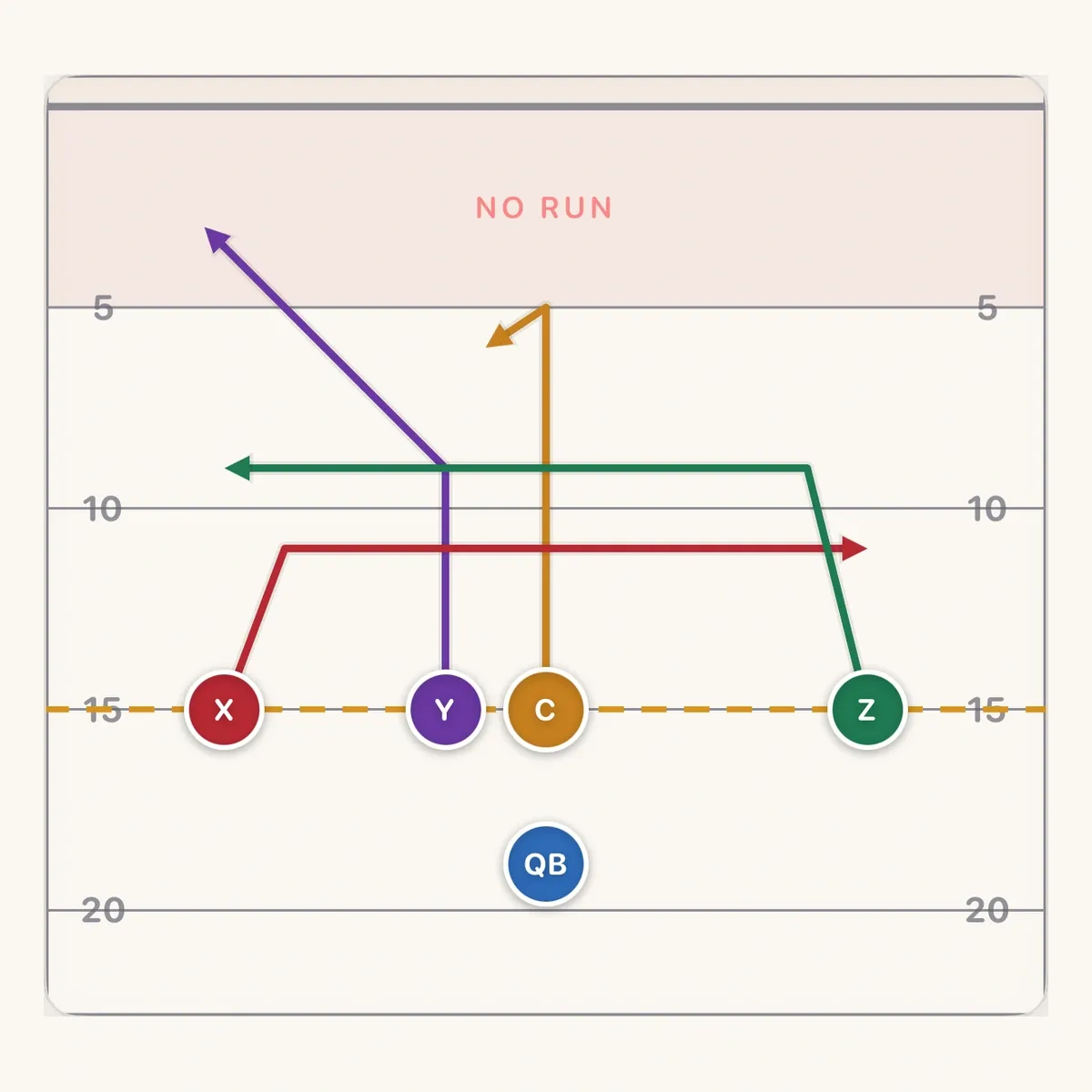
Keep the two drag depths separate. X stays lower while Z runs above. The crossing receivers pass close, keep moving and avoid contact. Neither player can stop to block a chasing defender or set an intentional pick.
Have the quarterback lead the open receiver. A pass behind a crosser forces a turn back toward the defender. A pass into the space ahead lets the receiver catch while moving away. Practise each crossing direction so the quarterback can throw comfortably to either side.
If the defense switches receivers at the crossing point, watch for a new defender facing the incoming route. Work to C behind the traffic if that lane opens. Double Under offers another crossing call, with both drags travelling across from a bunch release.
Center Pivot wins with the return
Use Center Pivot with 6 yards to the goal line. C pushes three hard steps toward trips, reaches 3 yards downfield and pivots back toward the empty side near 3.5. Your quarterback throws as C plants to turn.
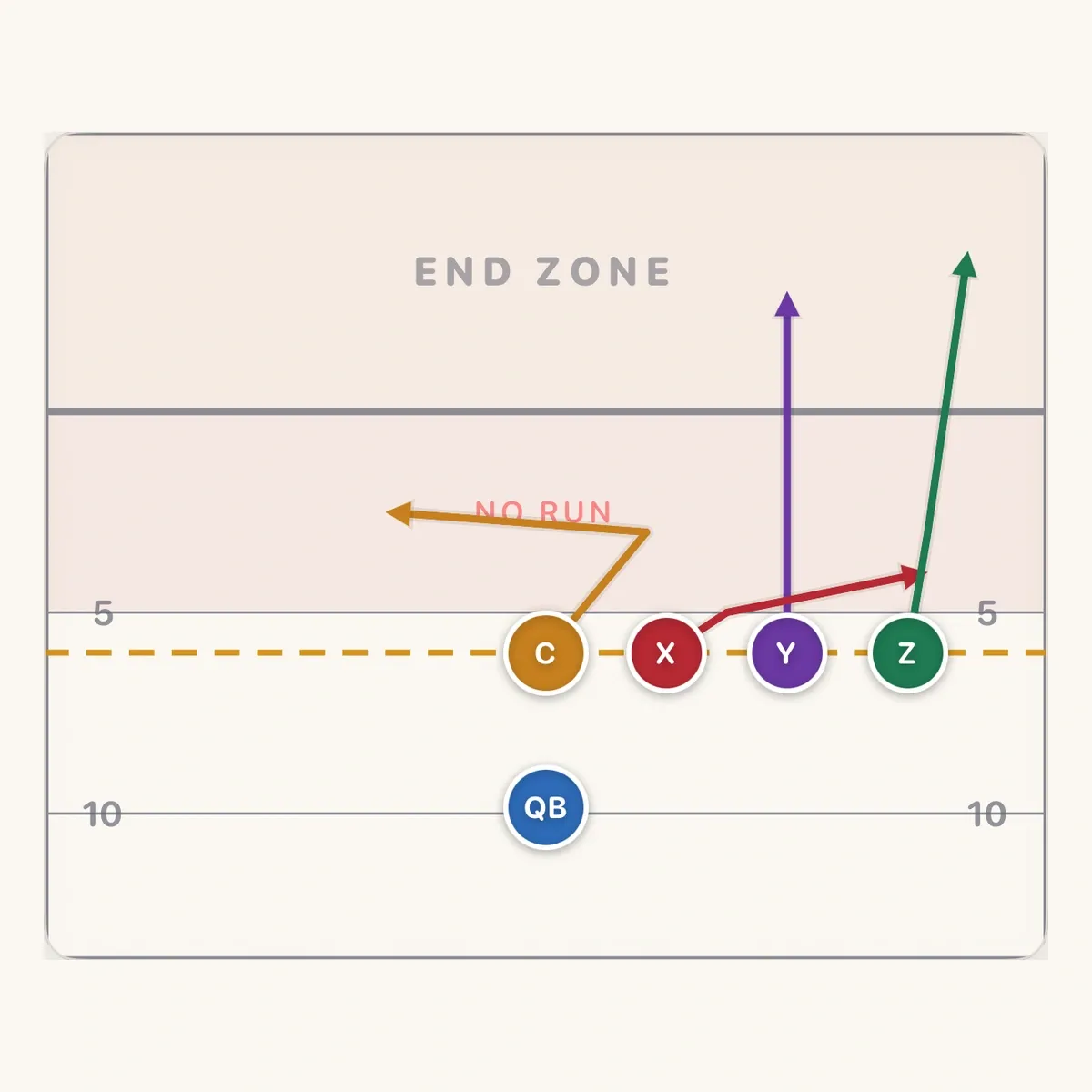
Ask C to commit to the first direction. The defender needs a reason to follow before the receiver turns back. Keep the plant sharp and the return under control so C can look for the pass immediately.
X widens into the flat on the trips side, Y runs the seam and Z the outside fade. Those routes give C room to return. Teach every receiver the whole spacing picture so nobody wanders into the empty side before the center arrives.
A patient defender can wait on the pivot. If that happens, your quarterback moves to X in the flat and Z on the fade. On the next call, make that defender run across the field with Mesh Drive instead of repeating the same return route.
Slot Fade Switch changes the release
Call Slot Fade Switch from trips right with 2 yards to the goal line. Y goes outside Z and climbs toward 7.5 yards. Z releases underneath and slants inside toward 5. Your quarterback looks to Y on the fade, then Z, X in the flat and C on the back side.
Walk the exchange with both receivers before adding defenders. Leave each player a clean running path. If the defenders switch assignments, your receivers continue their routes without trying to collide with the new matchup.
Practise the fade with the sideline marked. Place the ball high toward the back corner while leaving room for Y to catch inside the field. Keep throwing the slant during the drill too, so the quarterback is comfortable moving down from the first read.
Build a short separation practice
Begin with a receiver and defender working one route. Run the drag, pivot or switch release at a walking pace, then increase speed. Watch the receiver’s feet and direction before judging the pass. Fix a rounded turn before adding another defender.
Move to the full play once the individual route is clear. Give the quarterback a defender who chases on one repetition and one who stays square on the next. The quarterback decides whether the first read has separated and moves on when it has not.
Finish with the defense choosing its own adjustment. Ask the quarterback who was open and why. Keep the call familiar while changing the defender’s behaviour. That teaches the read without filling the session with new play names.
Keep separation legal
Flag football is non-contact. Receivers run routes, avoid defenders and keep moving through traffic. No blocking or picks are allowed. Stop a repetition when a player tries to hold a path open with the body.
Near an IFAF goal-line no-run zone, call a pass. NFL FLAG also has a no-run zone before midfield. Your quarterback cannot run directly past the line with the ball. Use the red-zone guide to practise the same separation ideas with tighter boundaries.