
 RoutrGet Routr
Start with the goal line and boundaries
The closer you get to the goal line, the less room your receivers have to stretch the defense. Put the goal line, sidelines and back boundary into every practice repetition. A route that looks open before the catch still needs enough space for the receiver to finish in bounds.
Keep your quarterback’s first decision clear. Choose a short change of direction, a high-and-low outside pair or two crossing lanes. Those choices ask different questions of the defense. Use the answer from the previous snap to choose the next call.
Flag football is non-contact. Receivers must run their own routes without blocking or setting picks. Keep the quarterback behind the line to pass. In a no-run zone, plan the passing action before the snap so a closed first read does not send the offense into an illegal run.
Center Pivot attacks the empty side
Call Center Pivot from trips right with 6 yards to the goal line. C pushes three hard steps toward the trips side, reaching 3 yards downfield, then turns back toward the empty side near 3.5. Your quarterback throws as C plants.
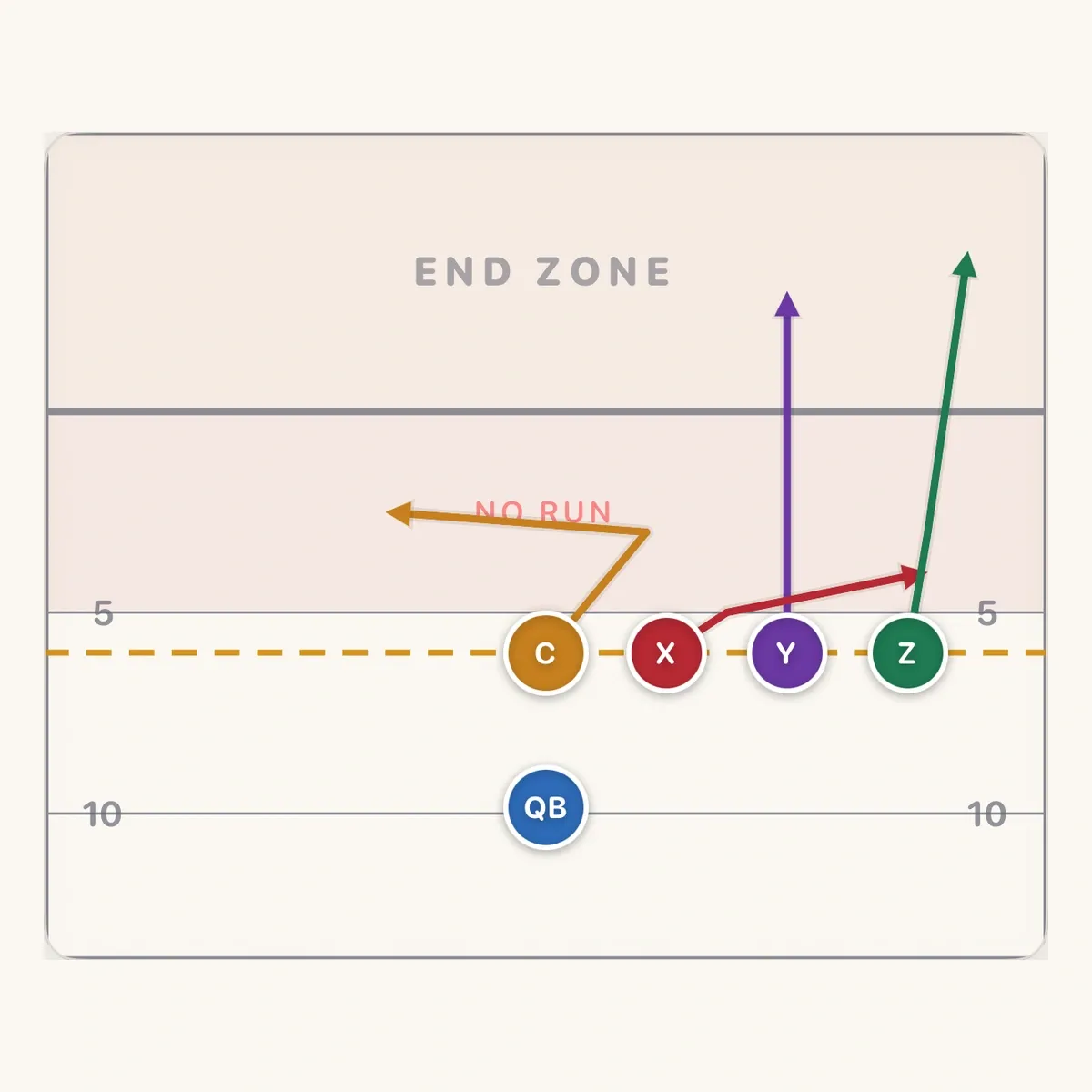
Use it against a man defender who follows the first movement too eagerly. Keep X widening into the flat while Y and Z run vertically. That spacing clears the short return lane. If the defender waits on the pivot, move to X in the flat, then Z on the fade.
Practise the first throw with C and the quarterback alone. Add the man defender after the plant and pass arrive together. Do not ask the quarterback to hold the ball until C has stopped and the defender has recovered.
Smash Return makes the corner choose
Call Smash Return against Cover 2 or a soft corner with 6 yards to the goal line. Z runs a hitch to 5 yards and comes back to 4. Y breaks toward the corner from 5 to 10. Throw Y when the outside defender sits low, or Z when that defender drops.
Keep Y’s route moving toward the back pylon while Z returns toward the quarterback. If both receivers drift to the same depth, the high-and-low choice disappears. Mark their finishing spots when you walk the play.
C turns back across the middle near 4.5 yards as the third read. X’s slant gives you a hot throw against pressure. Run those routes during every outside-pair drill so the quarterback can find them without searching once the rush arrives.
Goal Line Mesh crosses the short field
Use Goal Line Mesh from stack left with 2 yards to the goal line. X crosses at 2 yards and Z at 4. The quarterback looks for whichever crosser separates, then C at the back line and Y on the corner.
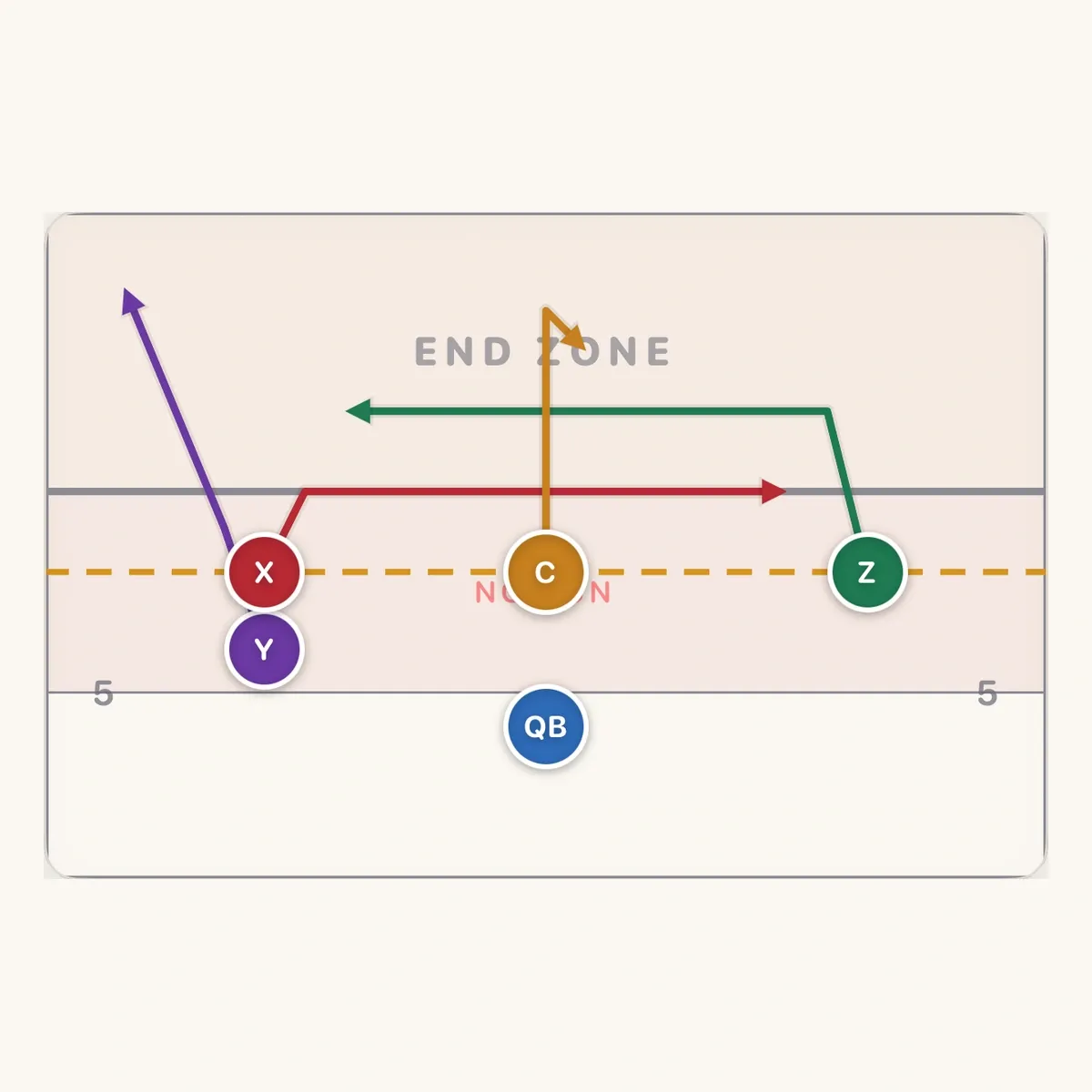
Keep X and Z on their own tracks. They pass close but never stop to block a defender. Have each receiver practise the catch while continuing across, with the sideline visible ahead. The quarterback leads the pass into open space inside that boundary.
C pushes to 6.5 yards and settles back near 5.5. Y’s corner climbs through 3 toward 9. Walk those routes with the actual back boundary marked and keep every player inside the field. The end zone is short, so everyone stays in bounds.
Change the call when defenders adjust
If the defense waits in zones under the crossing routes, use Smash Return to separate a short outside target from a deeper corner. If man defenders follow the outside pair tightly, use Center Pivot to make C reverse direction into the empty side.
Slot Fade Switch gives you another man-coverage call at 2 yards to the goal line. Y releases outside Z and heads toward the back corner while Z slants underneath. Use it when your quarterback can place the fade inside the boundary and still move to the slant when deep help stays over Y.
Rehearse the passing rules
Under IFAF 5v5 rules, no-run zones sit before the goal lines. NFL FLAG also marks a no-run zone before midfield. Check your league rules and mark the applicable zones in practice. Your quarterback cannot run directly past the line of scrimmage with the ball. Rolling or moving to find a throwing lane still ends with a pass behind that line.
Remind receivers to avoid contact even when the space is crowded. A route through traffic is useful only if every player keeps running legally. Stop and reset a repetition if a player stands in a defender’s way to free a teammate.
Finish with a short scoring series
Start with Center Pivot against a chasing defender. Run Smash Return against a corner who alternates between sitting and dropping. Finish with Goal Line Mesh against man defenders, then let the defense switch to zone so your quarterback sees the difference.
After each pass, ask where the catch happened and which defender decided the throw. Keep the route depths steady while changing the coverage. Pin the calls your team can execute in Game Day, and carry the same numbers onto your wristbands.